





Privacy is a data architecture problem. We engineer the solution.
bladestack.io builds privacy programs grounded in the NIST Privacy Framework. We translate abstract Functions into concrete processing controls, consent enforcement mechanisms, and data lifecycle automation. Not policy theater. Operational privacy.
- Home
- NIST Privacy Framework Advisory | bladestack.io | Privacy Engineering
Why bladestack.io?
Privacy Engineering, Not Privacy Paperwork.
Most privacy consultants start with templates. Draft a policy. Check a box. Move on. The result is documentation that describes privacy aspirations while your systems continue processing data however engineers originally designed them.
We start somewhere different. We start with your data flows.
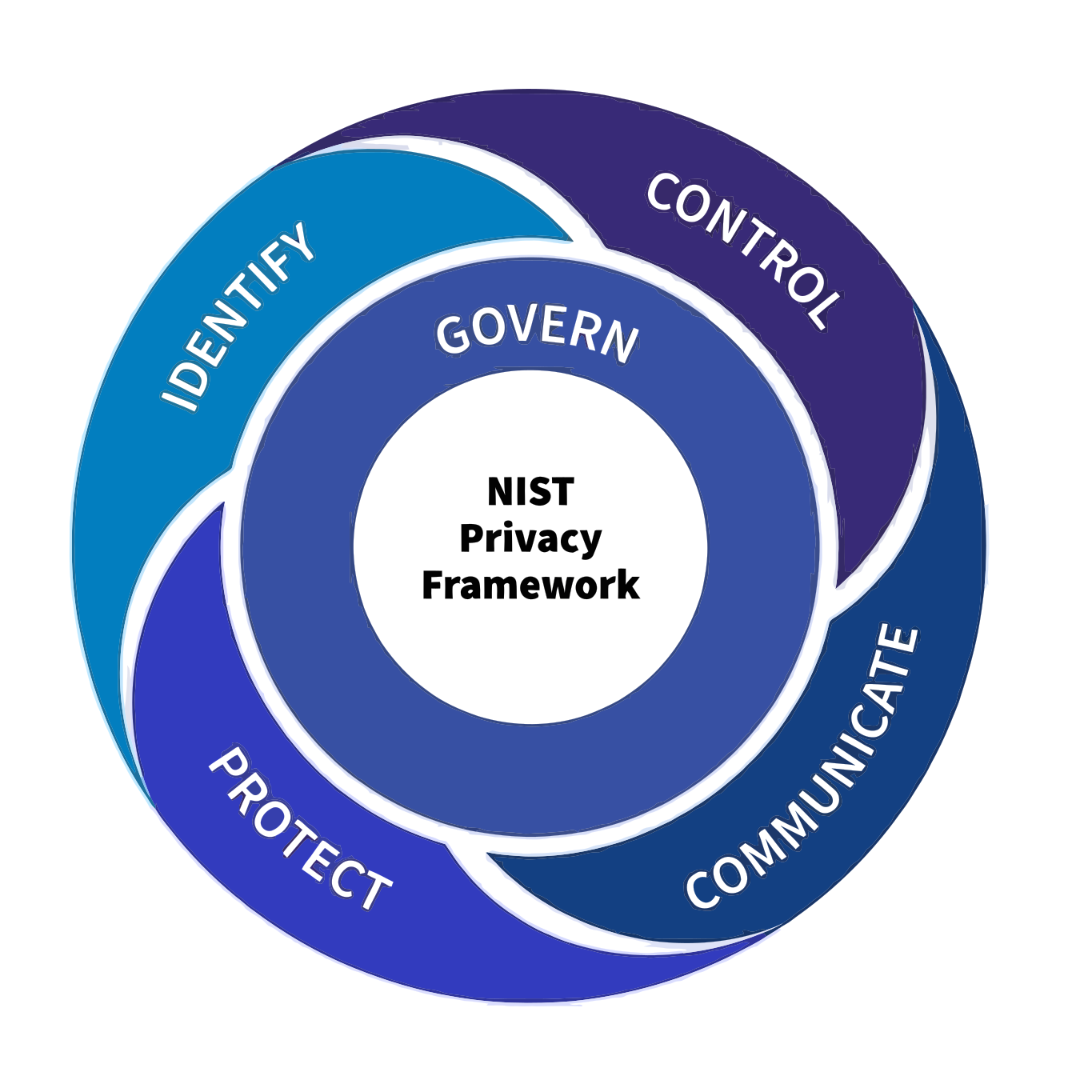
The NIST Privacy Framework defines five Functions: Identify-P, Govern-P, Control-P, Communicate-P, and Protect-P. These are not documentation categories. They are architectural requirements. Identify-P means knowing where personal data lives, how it moves, and what transforms it. Control-P means building systems that enforce processing boundaries, honor retention policies, and execute deletion requests without manual intervention. Communicate-P means generating evidence that your stated practices match your actual behavior.
We hire engineers who understand database schemas, event pipelines, and identity resolution. When your team asks how to implement CT.DM-P4 (data element deletion) across a distributed system with eventual consistency, we do not escalate to someone who "might know." We discuss tombstone records, cascading deletes, and backup retention windows. In detail.
The Framework's privacy engineering objectives, predictability, manageability, and disassociability, are not abstract principles. They are system design constraints. Predictability means your data processing behaves the way users expect. Manageability means you can alter, delete, or disclose specific data elements on demand. Disassociability means you process what you need without unnecessary identity linkage. These are engineering problems. We solve them like engineers.
Differentiators
Same Industry. Different Architecture.
Advisory-only. Engineer-led. Topology-first. Constraint-deployed. Here is what those words actually mean for privacy engineering.
We Distinguish Privacy From Security
Ask your current privacy consultant to explain the difference between confidentiality and disassociability. Ask them why the Framework includes Protect-P as a separate Function when the Cybersecurity Framework already covers protection. Ask them when privacy risk increases despite perfect security controls. Most cannot answer. They treat privacy as a subset of security because that is how their careers trained them. The Framework explicitly rejects this framing. Privacy risks arise from authorized data processing, not unauthorized access. Your data is encrypted, access-controlled, and audit-logged. And your processing still creates dignity harms, discrimination risks, and autonomy violations that encryption cannot address. We understand this distinction because we have built systems on both sides. Security engineering protects the perimeter. Privacy engineering shapes what happens inside it.
We Map Processing Topology, Not Just Data Inventory
Data inventories list what you have. Processing topology maps how it flows. The difference matters because privacy risk lives in the edges, not the nodes. A data inventory tells you that you store email addresses in Salesforce. Processing topology tells you that email addresses flow from your signup form to Salesforce to Marketo to your data warehouse to a machine learning feature store to a model training pipeline to an inference endpoint that personalizes pricing. Each edge in that graph is a data action. Each data action creates privacy risk. The Framework's Identify-P Function requires understanding this topology, not just cataloging storage locations. We map processing topology using the techniques your data engineers already understand: lineage graphs, dependency tracing, and schema analysis. The output is not a spreadsheet. It is a directed graph that shows every data action, every system boundary crossing, and every point where consent state must propagate.
We Deploy Constraints, Not Policies
Policies describe intended behavior. Constraints enforce actual behavior. The gap between them is where privacy incidents live. Your privacy policy states that you honor opt-out requests within 30 days. What constraint in your infrastructure enforces this? Your cookie notice claims you do not track users who decline. What mechanism prevents your analytics tags from firing? Your data retention schedule specifies 7-year deletion. What automated process executes deletion, and does it reach backup tapes? We engineer the constraints that close these gaps. Consent enforcement at the ingestion layer. Retention TTLs in your object storage lifecycle policies. Purpose limitation through schema-level access controls. The Framework's Control-P Function becomes operational when constraints exist in code, not just documentation.
We Build for the Three Objectives
The Framework defines privacy engineering through three objectives from NISTIR 8062. Most consultants cannot name them. We architect systems around them.
Predictability: We trace consent propagation across your processing topology and identify every point where user expectations diverge from system behavior. Then we close the gaps, either by changing the processing or by changing the communication.
Manageability: We audit your data architecture for element-level addressability. Can you locate, modify, and delete specific data elements on demand? If your architecture stores denormalized copies, how do you propagate changes? We design the access patterns and APIs that make subject rights technically feasible.
Disassociability: We analyze your processing activities for over-identification. Where do you link identity when aggregates would suffice? Where do you retain identifiers beyond operational necessity? We design pseudonymization strategies, aggregation pipelines, and tokenization schemes that reduce linkability without breaking functionality.
Advisory-Only. No Assessment Conflicts.
We do not audit privacy programs. We build them. This matters because privacy advisory and privacy assessment create structural conflicts. Did they recommend that retention approach because it minimizes risk, or because it simplifies their upcoming assessment? Did they overlook that consent propagation gap because it is immaterial, or because documenting it creates more work? The Framework is voluntary. No certification body stamps your Profile. No auditor declares you compliant. This means the only measure of success is operational capability: can you actually fulfill a deletion request across all systems? Can you demonstrate lawful basis for every processing activity? Can you generate evidence that your stated practices match your actual behavior? Our revenue depends entirely on building programs that achieve these capabilities. Nothing else creates misaligned incentives.
Fixed-Price Topology Engineering
We quote fixed prices for defined processing scopes. No hourly anxiety. No scope creep invoices. No "your topology was more complex than we expected" charges after work begins. The tradeoff: you follow our methodology. We have mapped enough processing topologies to know where complexity hides. Event-sourced architectures. Multi-cloud data residency. Legacy systems with undocumented data flows. Our process accounts for these. Clients who follow it get predictable outcomes at predictable costs.
Service Lines
Choose your blade.
Flexible engagement models to suit your mission. From strategic advisory to fully managed platforms.
-
For organizations that need to operationalize privacy controls within complex environments.
NIST Privacy · Advisory Services -
Technical firepower when your team needs reinforcement.
NIST Privacy · Engineering Services -
Ongoing operations, continuous monitoring, and security, handled.
NIST Privacy · Managed Privacy Operations
bladeRAMP -
Privacy engineering for the age of Large Language Models and Machine Learning.
NIST Privacy · AI & Ethics -
Harmonizing NIST Privacy with GDPR, CCPA, and HIPAA
NIST Privacy · Framework Interoperability
NIST Privacy · Advisory Service Components
For organizations that need to operationalize privacy controls within complex environments
Writing a policy is easy. Enforcing it across a Kubernetes cluster processing terabytes of data is hard. We bridge the gap between legal requirements and engineering reality. We identify, govern, control, communicate, and protect your data privacy posture by building the artifacts that prove you are doing what you say you are doing.
-
Privacy Engineering Gap Assessment For organizations evaluating their privacy posture. This is not a legal review; it is a technical diagnostic. We assess your current architecture against the NIST Privacy Framework Core (Identify, Govern, Control, Communicate, Protect). We identify the "privacy technical debt" in your system, where your data collection outpaces your consent mechanisms and where your storage lacks minimization controls. You get a comprehensive remediation roadmap, not just a list of findings.
-
Phase 0: Telemetry Discovery For organizations committed to the full build. We bypass the standalone report and move straight to architectural definition. We deploy discovery tools to map your actual data lineage, ingest pipelines, and storage schemas. We produce the foundational artifacts (Data Inventory Map, Control Ownership Matrix, Schema Registry) and immediately start engineering the solution.
-
Advisory - Privacy Architecture Build The heavy lift. We develop the full suite of NIST Privacy Framework artifacts, but with an engineering focus. System of Records Notices (SORNs) that match database reality. Privacy Impact Assessments (PIAs) that analyze API specifications. Data retention schedules that map to CRON jobs. We document the system as it runs, embedding with your team to solve implementation challenges.
-
Validation & Stress Testing We test the controls. We simulate data subject requests (DSARs) to see if your system breaks. We attempt to re-identify "anonymized" data. We validate that your encryption keys are managed correctly and that your access logs are tamper-evident.
Every artifact is derived from system reality. We do not copy-paste privacy promises. We document the actual constraints, flows, and safeguards of your environment. This is documentation that your Data Protection Officer can trust and your Site Reliability Engineers can respect.
Includes:
-
Data Lineage & Telemetry Audit
-
Phase 0 (Schema Discovery)
-
Privacy Impact Assessments (PIA)
-
System of Records Notices (SORN)
-
Data Inventory & Mapping
-
Consent Management Architecture
-
Third-Party Data Flow Analysis
NIST Privacy · Enjinia Blade Division
Hands-on privacy engineering, de-identification, and control implementation.
Sometimes you need more than advice. You need an engineer to rewrite a Kafka consumer to mask PII before it hits the data lake. Our Enjinia Blade Division provides Bitstream Mercs who specialize in privacy enhancing technologies (PETs). We don't just talk about minimization; we refactor the schema to enforce it.
-
De-identification Engineering Implementation of advanced cryptographic privacy controls. We configure hashing, salting, tokenization, and format-preserving encryption. We implement differential privacy algorithms to allow data analysis without compromising individual identity.
-
DSAR Automation Manual Data Subject Access Requests are a security risk and a resource drain. We architect and build automated workflows that programmatically query, collate, and package user data from across your disparate systems, reducing response time from days to seconds.
-
Consent Propagation Architecture We build the event bus for user choice. When a user updates their preferences, we engineer the webhooks, API calls, and database updates that ensure that preference is respected by every downstream service and third-party vendor immediately.
-
Retention Policy Enforcement Data hoarding is a liability. We configure lifecycle policies on object storage, TTL indices on databases, and automated purge scripts that ensure data is destroyed exactly when it should be, verified by audit logs.
These are not policy consultants. These are engineers who know Python, SQL, and Infrastructure-as-Code. They embed with your team to turn privacy requirements into functioning code and configured infrastructure.
Includes:
-
Architecture & Design Consulting
-
Control Implementation Engineering
-
Remediation Support
-
Infrastructure-as-Code Development
-
Security Stack Deployment
-
Code Review & Configuration Audit
-
Cryptographic Control Implementation
-
DSAR Automation Engineering
-
Consent State Machine Design
-
Data Retention Automation
-
Synthetic Data Generation
-
API Gateway Privacy Filtering
NIST Privacy · bladeRAMP Managed Privacy Operations
Continuous privacy monitoring and data governance operations
Your data environment changes every deployment. A privacy assessment becomes obsolete the moment a developer adds a new logging statement. bladeRAMP Privacy Operations provides continuous oversight of your data landscape. We monitor for schema drift, unauthorized data egress, and privacy control failures in real time.
-
bladeRAMP The complete managed compliance platform. Includes Platform Build (security stack, architecture, and management layer), HANZO SecOps, GENJI ConMon, and SRE infrastructure capability. Full-stack compliance operations from the team that built your package.
-
Continuous Schema Monitoring We watch your databases. When a new column appears that resembles PII, we alert. When a table's access pattern changes, we investigate. Your data inventory remains accurate without manual documentation sprints.
-
Privacy Operations Center Operational management of privacy requests. We handle the technical execution of DSARs, manage opt-out registries, and oversee consent preference databases. High availability. Verified accuracy. Your privacy team handles policy. We handle plumbing.
-
Vendor Data Governance You are responsible for the data you send to processors. We monitor data egress points to verify you send only what contracts permit. We track vendor certifications and flag supply chain compliance drift.
-
Incident Response Support When breaches occur, you need a plan that executes immediately. We manage the technical response: scoping impact, isolating affected data, generating forensic reports, and supporting notification requirements.
Privacy is a dynamic state. We provide the operational layer that keeps your system aligned with the NIST Privacy Framework regardless of how fast your engineering team ships features.
Includes:
-
Continuous Schema Monitoring
-
DSAR & ROPA Management
-
Vendor Risk Monitoring
-
Data Egress Surveillance
-
Breach Response Forensics
-
Quarterly Impact Updates
NIST Privacy · AI & Data Ethics
Privacy engineering for the age of Large Language Models and Machine Learning
The NIST Privacy Framework now intersects heavily with the NIST AI Risk Management Framework. Training models on customer data introduces risks that traditional controls cannot catch. We engineer the safeguards required to build AI that respects privacy.
-
Training Data Sanitization Before data reaches the GPU, it must be clean. We build ETL pipelines that strip PII, scrub identifiers, and verify that training datasets align with privacy commitments before a model ever sees them. Provenance tracking from source to training run.
-
Inference Privacy Guardrails Preventing models from memorizing and regurgitating sensitive data. We architect input/output filtering layers and red-team your models for privacy leakage and training data extraction attacks. The controls that keep PII out of model responses.
-
KSI-Aligned Architecture Design Infrastructure that inherently meets 20x requirements, immutable resources, zero-trust networking, least-privilege access, automated configuration management. When your architecture is built for compliance, evidence generation becomes automatic.
-
Algorithmic Impact Assessments Technical evaluation of automated decision-making systems. We analyze the logic, the inputs, and the outcomes to detect bias, ensure fairness, and validate that privacy choices are not overridden by algorithmic optimization.
You cannot retroactively add privacy to a trained model. We help you build the data infrastructure that allows AI innovation without compromising user trust or compliance posture.
Includes:
-
Training Data Scrubbing Pipelines
-
Model Privacy Testing
-
AI Risk Management Alignment
-
Automated Decision Logic Audit
-
LLM Privacy Controls
NIST Privacy · PRISM - Privacy Regulatory Interoperability and Standards Mapping
Harmonizing NIST Privacy with GDPR, CCPA, and HIPAA
Compliance should not be additive. You should not build a separate privacy stack for Europe, another for California, and a third for healthcare. PRISM is our engineering interoperability layer. We treat your core data architecture as the single source of truth and map it to the necessary regulatory outputs. We refract your foundational controls into compliance across every jurisdiction without duplicating infrastructure.
-
GDPR / EU Interoperability Refracting NIST controls into GDPR compliance. We map the "Identify-Govern-Control" functions directly to the Articles of GDPR. We identify the specific engineering deltas, particularly around lawful basis and cross-border data transfer, and implement the necessary technical bridges.
-
State Law Alignment (CCPA/CPRA) The US state privacy landscape is fragmented. PRISM harmonizes the requirements of California, Virginia, and Colorado into a single "highest common denominator" technical standard. We engineer the system to meet the strictest constraint, ensuring you are compliant everywhere by default.
-
Health Data Overlay (HIPAA) Integrating the NIST Privacy Framework with the specific mandates of the HIPAA Privacy Rule. We focus on the engineering intersection of patient safety and data privacy, implementing the specific access controls and audit trails required for PHI environments.
-
Global Transfer Mechanisms Engineering the pathways for lawful data movement. We implement the technical measures required for Standard Contractual Clauses (SCCs) and Transfer Impact Assessments (TIAs), ensuring your cross-border data flows are legally defensible and technically restricted.
Do not build a patchwork of compliance programs. Build a single, robust privacy architecture. PRISM ensures that your engineering investment satisfies multiple regulatory regimes simultaneously, turning a complex legal landscape into a managed engineering standard.
Includes:
-
GDPR Technical Cross-Walk
-
CCPA/CPRA/VCDPA Alignment
-
HIPAA Privacy Rule Integration
-
Cross-Border Data Flow Engineering
-
Transfer Impact Assessment (TIA) Support
-
Unified Control Framework Mapping
Our Approach
How We Engineer Privacy.
Most firms view privacy as a documentation burden. We view it as a quality attribute of your system, like scalability or reliability. Our approach moves the heavy lifting from the legal department to the engineering department, where the data actually lives.
00.
PHASE 0: Data Discovery Fast Track
For organizations committed to engineering privacy, not just documenting it
Traditional privacy assessments produce reports that sit in folders while you figure out what to do next. We skip that. Phase 0 is an intensive data discovery sprint that flows directly into architecture and implementation. No handoff. No ramp-up. No wasted time.
Phase 0 does not produce a static report. It produces foundational artifacts:
-
Automated Data Inventory Map
-
Data Flow Diagrams (Network & Application Layer)
-
Toxic Combination Analysis (re-identification risk)
-
Shadow Data Identification (the PII nobody documented)
Everything discovered flows directly into the Privacy Architecture Build. No assessment to review. No second engagement to negotiate. We are already building.
01.
NIST Privacy · Privacy Posture Analysis
For organizations evaluating the privacy engineering journey
Not ready to commit to the full build? Start here. Our Privacy Posture Assessment is a technical deep-dive that tells you exactly where your privacy program stands, and exactly what it will take to achieve operational maturity.
We do not rely on questionnaires and interviews. We scan your systems. We analyze schemas to identify PII at the field level. We trace data flows to see where personal data actually moves. We find the logging statements capturing sensitive data your team forgot about.
-
Comprehensive Privacy Maturity Report
-
Data Flow Analysis with PII Mapping
-
Control Gap Prioritization
-
Realistic Timeline and Resource Projections
-
Remediation Recommendations with Implementation Guidance
02.
NIST Privacy · Advisory & Privacy Architecture Build
Encoding constraints into the platform
Once we know the truth, we build the controls.
We do not write a policy that says "encrypt sensitive data." We help you configure the KMS, rotate the keys, and enforce TLS versions. We create Privacy Impact Assessments that reference specific API endpoints and microservices. We build the Consent Architecture that traces preference propagation across your service mesh.
We build "Privacy by Design" into the architecture so that compliance becomes the default state, not an afterthought.
-
Engineering-Grade Privacy Documentation
-
Data Lifecycle Automation Configurations
-
Consent Management Integration Plans
-
Technical Privacy Control Matrix
-
Retention Policy Implementations
When your team discovers a consent propagation gap three days before a product launch, we answer directly, with implementation specifics, not a link to a framework document.
Every artifact built for your specific architecture. Documentation your engineers can actually use for operations, onboarding, and regulatory response.
03.
NIST Privacy · Validation Support
We stay until your privacy program is battle-tested
The engagement doesn't end when the documents are signed. Validation is where we prove the architecture holds up. We act as the adversary to your privacy controls, standing between your system and the risk of a breach or audit failure. Privacy failures follow patterns: consent race conditions, leakage in error logs, retention policy failures, and re-identification of "anonymized" data. We engineer the validation suite to catch these before a regulator does. We simulate Data Subject Access Requests (DSARs) to test automation limits. We attempt to re-identify anonymized data. We stress-test the consent propagation bus to ensure downstream vendors receive opt-out signals.
-
Adversarial Privacy Testing
-
DSAR Workflow Stress Testing
-
Data Minimization Verification
-
Access Control Boundary Testing
-
Deletion Completeness Audits
Compliance is the baseline. Validation is the proof. Clean validation produces a defensible posture. That is the product of engineering discipline. That is what happens when engineers build the privacy program instead of just reviewing it.
NIST Privacy · Validated.
The Standard is Set
You are aligned. The data is governed. The architecture is robust. The work it took to get here, the schema mapping, the refactoring, the policy engineering, it paid off. Privacy doesn't stop at validation. Data environments are entropic. New schemas are deployed, new vendors are added, and new regulations emerge. Whether you handle operations internally or want a team that already knows your topology, the path forward is yours.
-
bladeRAMP Privacy Operations Continuous schema monitoring, vendor governance, and privacy operations center to manage the drift.
-
PRISM · Regulatory Mapping Expanding your privacy architecture to cover GDPR, AI Risk, or State Laws without rebuilding the foundation.
-
Enjinia Blade Services Ad--hoc engineering support when you need hands-on help with new data pipelines or architectural changes.
-
Privacy Officer Support Ongoing advisory for the DPO office, providing the technical answers required for complex regulatory questions.
Ready to See Your Data Truth?
Skip the policy review. Schedule a consultation with an engineer who reads schemas, not just statutes. We will discuss your data complexity, your architectural constraints, and whether we are the right fit. No obligation. No pressure.