


Risk-based security architecture. Built on the framework that defines modern cybersecurity.
bladestack.io delivers NIST CSF implementation with engineering precision. We translate the framework's abstract functions into concrete controls, measurable outcomes, and security programs that scale with your organization.
- Home
- Compliance
- NIST CSF Advisory Services | bladestack.io | NIST Cybersecurity Framework
Why bladestack.io for NIST CSF?
Security Programs, Not Compliance Theater.
NIST describes the Cybersecurity Framework as widely used guidance for reducing cybersecurity risk, designed for organizations of any size and sector. It is also the most frequently misapplied. Organizations check boxes against categories, produce maturity scores, and declare victory while their actual security posture remains unchanged.
The framework is designed to help organizations understand, assess, prioritize, and communicate cybersecurity risk. The CSF Core is a set of desired outcomes, organized by Function, Category, and Subcategory. These outcomes are not a checklist and the CSF does not prescribe how they must be achieved. Instead, NIST links the Core to a portfolio of online resources, including Informative References and Implementation Examples, that help translate outcomes into practical practices and controls.
Most consultants treat CSF as a spreadsheet exercise. Map current state. Identify gaps. Produce a report. Move on. That approach fails because it treats the framework as the destination rather than the vehicle.
We approach NIST CSF as what it actually is: a strategic scaffolding for building security programs that work. The framework’s Categories and Subcategories define outcomes. We convert those outcomes into implementation work by selecting relevant Informative References, defining evidence expectations, and translating them into engineering-ready tasks and operating procedures. Its functions become operational capabilities. Its profiles become living documents that evolve with your business.
When we assess against CSF, we are not scoring your maturity. We are identifying the architectural decisions, operational gaps, and capability investments that separate your current state from your target state. When we implement CSF, we are not filling out templates. We are building security infrastructure.
Differentiators
Same Framework. Different Philosophy.
Advisory-only. Engineer-led. No Surprises. Custom-built. Here is what those principles mean for NIST CSF.
Risk Architecture, Not Risk Checkboxes
CSF exists to manage risk. Most implementations treat it as a compliance requirement instead. Categories become checkboxes. Subcategories become yes/no questions. The result is a maturity score disconnected from actual security capability. We implement CSF as a risk management architecture. Every control maps to a threat. Every capability investment connects to business impact. Every gap prioritization reflects your specific risk tolerance, not a generic severity rating.
Engineers Who Build Security Programs
CSF subcategories reference technologies your team operates daily: identity management, network monitoring, incident response tooling, backup and recovery systems. Evaluating these controls requires understanding how they actually work, not just whether documentation exists. Our team has configured SIEM correlation rules, designed identity federation architectures, and built incident response playbooks in production environments. When we assess your Detect function, we evaluate detection logic. When we implement your Protect function, we configure controls.
Profiles Built for Your Organization
CSF Organizational Profiles are the framework's most powerful and least utilized component. They translate abstract framework language into specific organizational requirements. Most consultants skip this step, applying generic category mappings instead of building profiles that reflect your sector, your risk appetite, and your operational constraints. We develop Current State and Target State profiles that become strategic roadmaps, not shelf documentation.
Implementation Tiers That Reflect Risk Governance
The CSF Implementation Tiers (Tier 1 Partial, Tier 2 Risk Informed, Tier 3 Repeatable, Tier 4 Adaptive) characterize the rigor of an organization’s cybersecurity risk governance and management practices. They are meant to guide and inform how you manage risk over time, not to act as a universal maturity score.
Cross-Framework Intelligence
Agency security assessments follow patterns. Assessors ask predictable questions, dig into specific control families, and cross-reference documentation against interviews. We build packages that anticipate this scrutiny. When the assessor asks your system administrator about AU-6, the answer matches the SSP. When they review your CM-6 evidence, the configurations align with your narratives. Clean packages produce clean assessments.
Fixed Scope, Predictable Investment
CSF engagements are quoted at fixed prices for defined scopes. No discovery fees that balloon into implementation invoices. No hourly billing anxiety. No scope creep charges when complexity surfaces. The structure works because our methodology is proven. We know what questions surface ambiguity, what gaps indicate architectural problems, and what documentation efforts actually require.
-
For contractors with technical teams who need RMF expertise to navigate the agency authorization process
NIST CSF · Advisory Services -
Technical firepower when your team needs reinforcement
NIST CSF · Engineering Services -
Ongoing operations, continuous monitoring, and security, handled.
NIST CSF · Managed Service
bladeRAMP -
For organizations navigating multiple compliance requirements simultaneously
NIST CSF · Cross-Framework Services
NIST CSF · Advisory Service Components
For organizations building or maturing cybersecurity programs against the industry standard
The Cybersecurity Framework provides structure. We provide implementation. From initial assessment through program maturity, we translate CSF's abstract categories into concrete security capabilities, documented procedures, and measurable outcomes that satisfy stakeholders, customers, and regulators.
-
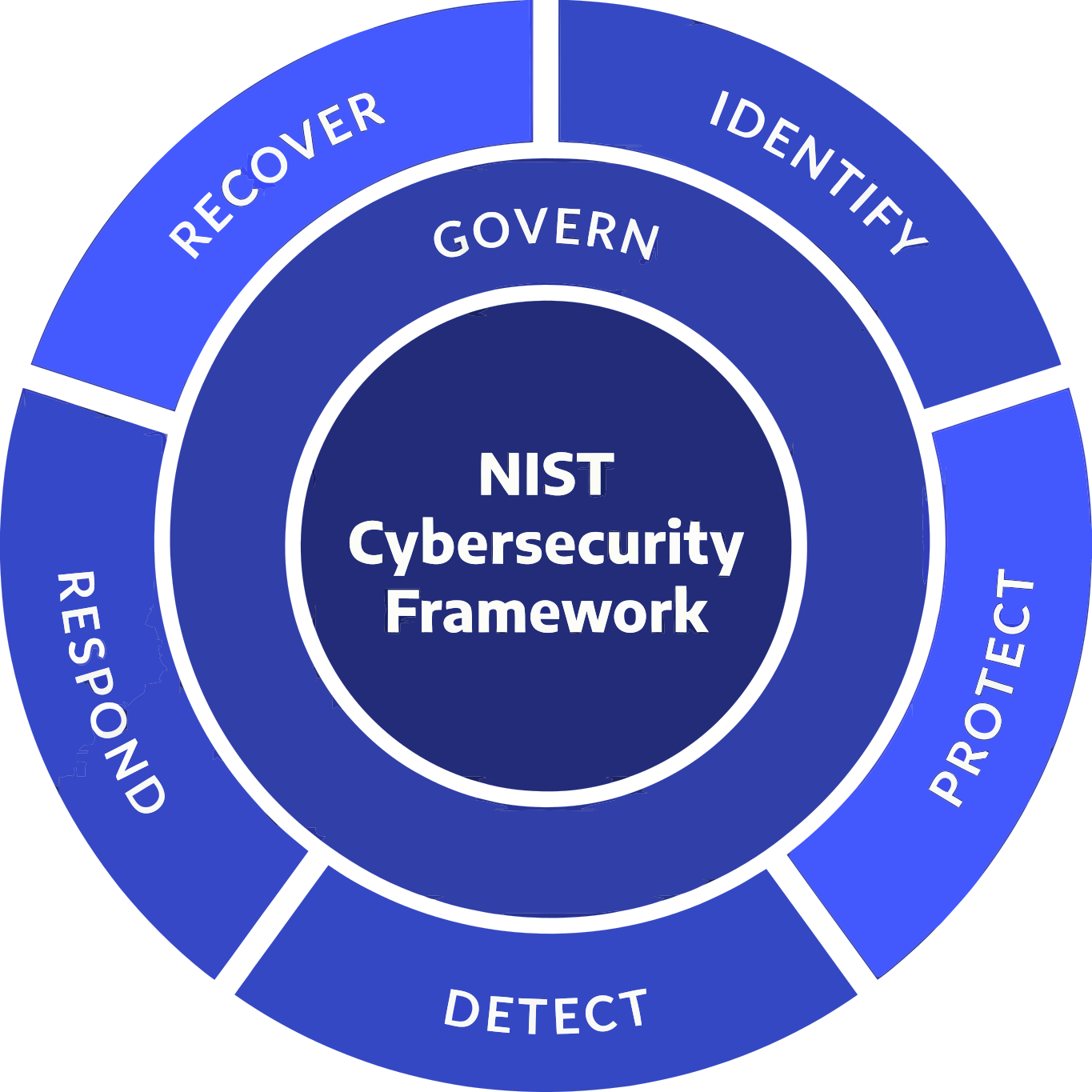
CSF Capability and Risk Posture Assessment Comprehensive evaluation across the six CSF 2.0 Functions. We assess how your current practices align to CSF outcomes, using an evidence-based approach and an organization-defined rating scale.
-
Organizational Profile Development CSF Profiles translate framework requirements into organizational context. We build Current State Profiles that document existing capabilities honestly and Target State Profiles that reflect business objectives, regulatory requirements, and risk tolerance. The delta between them becomes your security roadmap.
-
Implementation Advisory Gap identification without implementation guidance is useless. We provide control-by-control recommendations with technical specificity: tool requirements, configuration approaches, integration dependencies, and resource estimates. Your team receives actionable guidance, not abstract recommendations.
-
Governance Integration CSF 2.0 elevated Govern to a core function for a reason. Security programs fail when disconnected from organizational decision-making. We design governance structures that integrate cybersecurity risk into enterprise risk management, establish accountability, and create reporting mechanisms that executives can actually use.
-
Documentation Development Policies, procedures, and plans aligned to CSF categories and your operational reality. Every document reflects how your organization actually operates, creating artifacts that serve both compliance and operational purposes.
CSF implementation should produce a security program, not a compliance artifact. When we complete an engagement, your team has documented capabilities, prioritized investments, and a governance structure that sustains improvement. The framework becomes operational infrastructure.
Includes:
-
CSF 2.0 Maturity Gap Analysis with Prioritized Remediation Roadmap
-
Current State & Target State Profile Development
-
Tier Advancement Planning
-
Policy & Procedure Development
-
Governance Framework Design
-
Executive Reporting Structures
NIST CSF · Enjinia Blade Division
For organizations that need technical firepower, architecture, implementation, and remediation.
Assessment reports do not improve security posture. Implementation does. Our Enjinia Blade Division provides the engineering capability to translate CSF requirements into operational controls: security tooling deployment, detection engineering, identity architecture, and infrastructure hardening.
-
Detection Engineering CSF Detect function requires more than tool procurement. Effective detection demands correlation logic, alert tuning, and response integration. We build detection capabilities that identify threats, not generate noise.
-
Identity & Access Architecture Protect function subcategories around identity management and access control require architectural decisions that persist for years. Federation design, privilege management, authentication mechanisms, and lifecycle automation. We architect identity infrastructure that scales
-
Security Tool Deployment Endpoint protection, SIEM, vulnerability management, backup systems. The tooling that CSF references across categories requires proper deployment, configuration, and integration. We handle implementation so your team inherits operational capability.
-
Incident Response Development Respond function effectiveness depends on preparation. Playbook development, communication procedures, escalation paths, and recovery integration. We build incident response programs that work under pressure.
-
Network Segmentation & Architecture Protect function requirements around network integrity demand architectural investment. Segmentation design, firewall policy, micro-segmentation strategy. We design network architectures that enforce security boundaries
Engineering resources are not junior consultants with checklists. They are practitioners who have built the systems your CSF program describes. Engagements are scoped to the work required, whether focused implementation sprints or sustained capability development.
Includes:
-
Detection & Monitoring Engineering
-
Identity Architecture Design
-
Security Tool Deployment & Configuration
-
Incident Response Program Development
-
Network Security Architecture
-
Vulnerability Management Implementation
-
Backup & Recovery Engineering
NIST CSF · bladeRAMP Managed Services
For organizations that want security operations handled, not just designed
Building a security program is the first step. Operating it continuously is the enduring commitment. bladeRAMP provides managed security operations aligned to CSF core functions, delivering the capabilities your framework implementation describes without the staffing burden of internal operations.
-
bladeRAMP Complete managed security platform covering Detect, Respond, and Recover functions. Includes HANZO Security Operations, continuous monitoring, and infrastructure management. Full-stack security operations from the team that understands your CSF implementation.
-
GENJI · FedRAMP Continuous Monitoring (ConMon) Security posture requires continuous attention. Vulnerability lifecycle management, configuration drift detection, and compliance monitoring that sustains the program you built.
-
HANZO · 24/7 Security Operations (SecOps) 24/7 threat detection, incident response, and security monitoring. SIEM management, endpoint protection, threat hunting, and vulnerability management aligned to CSF Detect and Respond requirements.
-
Security Program Management Governance and oversight services for organizations that need strategic security leadership without full-time headcount. Risk register maintenance, policy lifecycle management, and executive reporting.
Platform Components
-
Platform Build The foundational deployment, landing zone architecture, security stack enablement, network segmentation, zero-trust remote access, and environment hardening. FedRAMP-ready infrastructure from day one.
-
HANZO · 24/7 Security Operations (SecOps) 24/7 threat detection, incident response, vulnerability management, and infrastructure protection. U.S.-based Security Operations Center staffed exclusively by U.S. citizens.
-
GENJI · FedRAMP Continuous Monitoring (ConMon) POA&M lifecycle management, scan analysis, evidence generation, monthly and annual deliverables, and agency reporting. Continuous monitoring on autopilot.
-
SRE Infrastructure Site reliability engineering capability for your authorization boundary. Infrastructure operations, patching, availability management, and operational support.
CSF describes security as a continuous function, not a point-in-time achievement. bladeRAMP transforms framework requirements into operational services. Your security program runs without consuming internal resources.
Includes:
-
Platform Build & Deployment
-
HANZO (24/7 Security Operations)
-
GENJI (Continuous Monitoring)
-
Annual Assessment Support
-
Agency Reporting & Communication
-
POA&M Lifecycle Management
-
SRE Infrastructure Operations
NIST CSF · Cross-Framework Services
For organizations navigating multiple compliance requirements simultaneously
NIST CSF rarely exists in isolation. It often serves as foundation while FedRAMP, CMMC, SOC 2, ISO 27001, HIPAA, or sector-specific requirements layer additional obligations. We design CSF implementations that anticipate future compliance needs, maximizing investment efficiency across frameworks.
-
CSF to FedRAMP Alignment Organizations pursuing federal authorization benefit from CSF foundations. NIST 800-53 controls map extensively to CSF categories. We build CSF programs that accelerate FedRAMP readiness.
-
CSF to CMMC Alignment Defense contractors often implement CSF before CMMC requirements crystallize. The frameworks share NIST heritage and significant control overlap. We design implementations that serve both purposes.
-
CSF to ISO 27001 Alignment ISO 27001 Annex A controls correspond to CSF subcategories. Integrated implementation reduces duplicative effort and creates unified security management systems.
-
Multi-Framework Roadmapping For organizations facing multiple compliance requirements, we design phased implementation strategies that sequence control investments for maximum efficiency. Build once, satisfy many.
Compliance requirements will multiply. Security investments should compound. Cross-framework design ensures that work performed today serves requirements that surface tomorrow.
Includes:
-
CSF to FedRAMP Mapping & Readiness
-
CSF to CMMC Alignment
-
CSF to ISO 27001 Harmonization
-
Authorization Boundary Diagrams
-
Policies, Procedures & Plans
-
Bastion Assessment Support
-
HIPAA Security Rule Alignment
-
Multi-Framework Roadmap Development
-
Unified Control Documentation
Our Approach
How We Build Security Programs.
Most consultants treat NIST CSF as an assessment exercise. We treat it as the foundation for security programs that actually work. Our phased approach builds capability systematically, from current state understanding through sustained operations.
00.
PHASE 0: Discovery & Profile Development
For organizations ready to understand their security posture honestly
Traditional CSF assessments produce maturity scores and gap lists. We produce Organizational Profiles that define current capability and target state with precision. Phase 0 establishes the foundation everything else builds upon.
Discovery does not produce shelf documentation. It produces:
-
Current State Organizational Profile
-
Target State Organizational Profile (aligned to business objectives)
-
Implementation Tier Assessment with Advancement Requirements
-
Prioritized Gap Analysis
-
Strategic Roadmap with Resource Projections
Phase 0 answers the questions that matter: Where are you? Where do you need to be? What does it take to get there?
01.
NIST · CSF Maturity Assessment
For organizations evaluating their security program against the industry standard
Not ready to commit to full implementation? Start here. Our maturity assessment evaluates your security program against CSF 2.0 core functions with technical depth that surfaces real capability gaps, not documentation deficiencies.
We do not assign arbitrary maturity scores. We evaluate:
-
Govern Organizational context, risk management strategy, roles and responsibilities, policy, oversight, and supply chain risk management
-
Identify Asset management, risk assessment, and improvement planning
-
Protect Identity management, awareness and training, data security, platform security, and technology infrastructure resilience
-
Detect Continuous monitoring and adverse event analysis
-
Respond Incident management, analysis, reporting and communication, and mitigation
-
Recover Recovery plan execution, recovery communications, and recovery improvement
Assessment output includes:
-
Function-by-Function Capability Analysis
-
Subcategory Implementation Status
-
Implementation Tier Positioning
-
Gap Prioritization Based on Risk Impact
-
Remediation Effort Estimates
02.
NIST CSF · Advisory & Package Engineering
Building the security program your organization requires
Analysis without implementation is consulting theater. We build the policies, procedures, governance structures, and technical capabilities that transform CSF categories into operational reality.
Documentation reflects your organization. Control implementations match your architecture. Governance structures integrate with your decision-making. The result is a security program your team can operate, not compliance artifacts they ignore.
Implementation includes
-
Policy Suite (aligned to CSF categories)
-
Procedure Development (reflecting actual operations)
-
Governance Framework Design
-
Risk Management Integration
-
Technical Control Implementation Guidance
-
Stakeholder Communication Materials
When technical implementation requires engineering, our Enjinia Blade Division provides hands-on capability. Detection engineering, identity architecture, security tool deployment. Whatever the CSF assessment identified, we can build.
03.
NIST CSF · Program Maturation.
Security programs require continuous improvement
CSF is not a destination. The framework explicitly calls for continuous improvement across all functions. After initial implementation, we support ongoing program maturation: periodic reassessment, tier advancement planning, and governance refinement.
For organizations that prefer external operations, bladeRAMP provides managed security services aligned to CSF functions. Your framework implementation becomes operational capability without internal staffing requirements.
Mature.
Security programs that improve continuously
You have a security program built on industry-standard architecture. Risk management is integrated with business decision-making. Security capabilities operate continuously. Improvement is embedded in operations.
CSF implementation is not a project with an end date. It is operational infrastructure that evolves with your organization. Whether you operate internally or leverage bladeRAMP, the program sustains.
-
NIST CSF · ConMon Advisory Services Continuous monitoring guidance, vulnerability reporting workflow support, and recertification readiness without handing off operations
-
NIST CSF · bladeRAMP Managed Services Full-stack compliance operations. Security monitoring, continuous compliance support, and a team that already knows your boundary.
-
NIST CSF · Bitstream Merc Engineering Ad-hoc technical resources when you need hands-on remediation, architecture changes, or implementation work.
Ready to Build a Security Program?
Skip the maturity score sales pitch. Schedule a consultation with engineers who understand both the framework and the technologies it references. We will discuss your current state, your business drivers, and whether we are the right fit. No obligation. No pressure.